

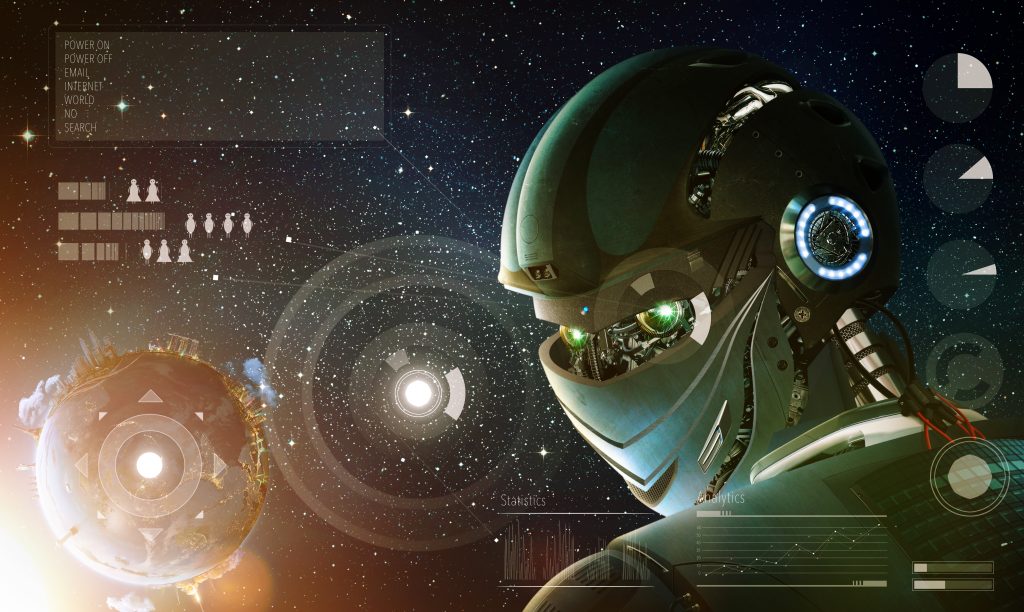
Have you ever pondered how machines can execute tasks that typically require human intelligence like recognizing speech or making decisions? The answer lies in Artificial Intelligence (AI) – a branch of computer science focused on creating intelligent machinery. In this article we’ll provide an overview of everything there is to know about AI including its history and basic principles as well as applications and potential impact on society.
Artificial Intelligence – An Introduction
Artificial Intelligence (AI) is a technology that enables machines to mimic human cognitive functions such as learning, reasoning, problem-solving, perception and natural language processing. It involves programming computers with algorithms so they can think like humans and make decisions based on data inputs rather than explicit instructions. AI has found applications in various industries including healthcare finance transportation entertainment among others. With its ability to process vast amounts of information quickly it offers immense potential for growth across different sectors.
AI is a subfield of computer science that concentrates on developing algorithms and software programs enabling machines to perform tasks typically requiring human intelligence. These include image recognition, speech recognition, decision making processes as well as language translation. There are various types of AI with distinctive capabilities applicable in different settings.
The idea of AI has been around for centuries but it wasn’t until modern computing emerged that significant progress was made in this field. Ancient Greek philosophers explored the concept by imagining mechanical thinking while researchers later experimented with electronic computers leading to creation of Logic Theorist – first ever AI program-in 1956. Since then there have been numerous breakthroughs every year making AI an exciting area of study today!
The Basics of AI
AI operates by utilizing vast amounts of data to train machine learning models that can detect patterns and make predictions. These models use statistical methods to identify correlations between input variables and output values enabling them to learn from experience and enhance their performance over time. There are several types of machine learning including supervised, unsupervised, and reinforcement learning each with its unique advantages and limitations.
Types of AI
AI is a rapidly advancing field with three main types of development: narrow or weak AI, general or strong AI and superintelligent AI. Narrow AIs are designed for specific tasks such as playing chess or driving cars while general AIs can perform any intellectual task that humans do. Superintelligence remains hypothetical but could potentially surpass human intelligence in all areas if developed. As technology continues to evolve at an unprecedented pace we may see these forms of AI become more prevalent in our daily lives.
AI Applications Across Industries
AI has become an integral part of various industries including healthcare, finance transportation and entertainment. In the medical field doctors are benefiting from improved accuracy when diagnosing diseases thanks to AI technology. Fraud detection is also made easier with automated systems powered by this innovative tech in financial institutions while self driving cars rely heavily on its capabilities for safe navigation during travels across different terrains or environments. As far as entertainment goes virtual assistants have revolutionized how users interact with content providers through personalized recommendations delivered via chatbots that use advanced algorithms based on machine learning principles provided by AI technology. The possibilities seem endless!
AI’s Impact on Society – The Future
The advancement of AI has sparked a heated debate among experts regarding its impact on society. Some argue that it could lead to widesp unemployment while others believe that new job opportunities will arise from this technology’s growth. Furthermore, policymakers must address concerns related to privacy security and fairness as they navigate through these changes brought about by AI. Ultimately, the potential for transformation offered by this innovation is immense – one which we cannot ignore or underestimate in our pursuit towards progressive societal development.
AI Myths – The Truth Revealed
Despite its increasing popularity there are still several misconceptions about what AI can and cannot do. One common myth is that it has independent thought or consciousness when in reality humans created this tool themselves. Another belief is that all human workers will be replaced by machines; however, the truth is that AI technology will enhance their abilities while creating new job opportunities simultaneously. Finally some people believe that AI poses a significant threat to society but actually depends on how well-designed and implemented it is – just like any other technological innovation.
AI is a captivating field that offers remarkable opportunities for enhancing our lives and tackling intricate challenges. By comprehending its background, principles as well as applications we can appreciate the potential of this groundbreaking technology more fully. As we advance into an era dominated by AI it becomes crucial to approach it with open minds while embracing change wholeheartedly.

